
Studying failure is a recipe for success in the collaborative economy.
Building two-sided collaborative marketplaces is hard – really hard. Companies in the space face a unique set of challenges, constraints and a complex web of relationships to navigate that in many ways represent a whole new era of doing business.
Over the past five years that we have been tracking the growing number of ventures in the space, we have seen many succeed beyond even their own expectations and go on to disrupt an entire industry. On the other hand, there is a growing list of start-ups that have made the call to shut their doors, or no longer exist in their original form.
Failure Mapping 2010-2014
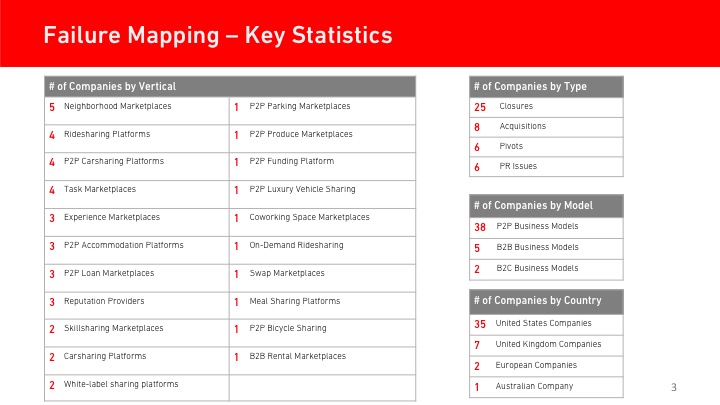
Earlier this year we conducted a review of 45 of the more significant collaborative economy start-ups across Europe/UK, Asia-Pacific and the United States, that have either closed down or experienced a potentially fatal setback to understand the common challenges in the space.
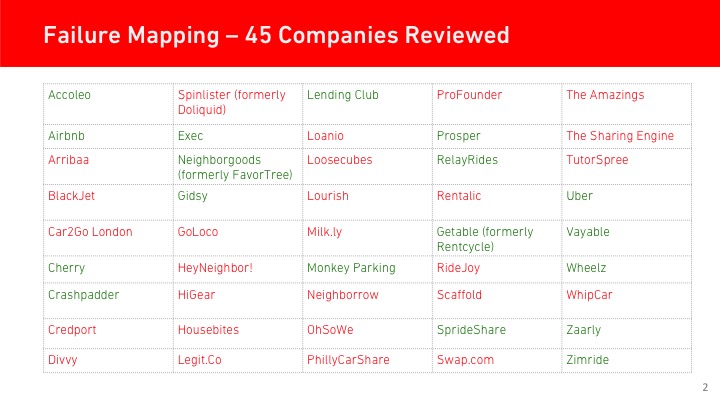 A number of the companies on our list are still in existence and indeed going through explosive growth (Airbnb, Uber, & Lending Club), however, we included them in order to identify the reasons behind some of their more significant setbacks or changes in direction. For instance, we included:
- PR ISSUES:
- TRUST – Airbnb due to its 2011 trust and safety breach, which ultimately became a successful defining moment for the company- others, however, have not survived similar challenges
- REGULATION – US peer-to-peer lending institutions such as Prosper and Lending Club, who received a cease-and-desist order and initially suspended activities, but eventually overcame these regulatory issues.
- PIVOTS: Start-ups such as Zaarly and Getable that didn’t fail but took a significant pivot that was driven by an insurmountable challenge with the previous business model.
- ACQUISTIONS: Companies such as Crashpadder that were acquired. Although this is generally regarded as a positive outcome for a young start-up, a number of companies we studied potentially pursued acquisition as a lifeline strategy.
- CLOSURES: Companies no longer in existence
The resulting ‘Failure Map’ gives us an insight into the most likely roadblocks a company will encounter, how the unique characteristics of two-sided marketplaces influence failure, and what killer combination of problems can result in closure. Note that this failure map is comprised of our observations, desktop research and discussions with people in the space, though we have not had one-on-one interviews with most of the companies reviewed. We appreciate every situation is nuanced and complex, but think these broad themes are still critical to understand.
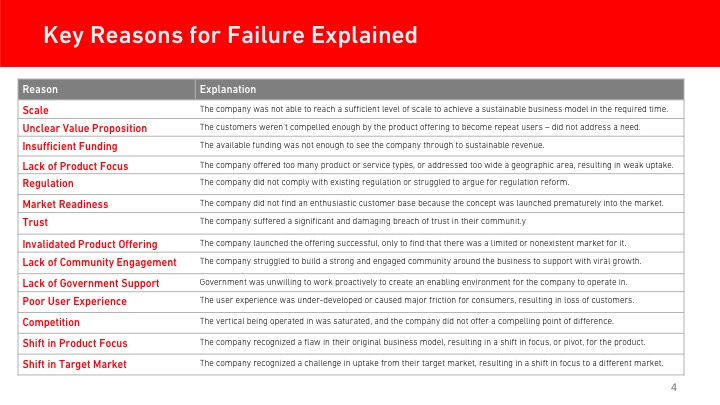
TOP FIVE FAILURE CHARACTERISTICS
- Scale
While it could be said that most companies need to reach scale in order to be successful, the unique dynamics of a two-sided marketplace, mean that the urgency of achieving a critical mass of both supply (‘providers’) and demand (‘customers’) is even greater, in order to demonstrate liquidity of the market and to provide a frictionless experience.
Almost a quarter (24%) of companies reviewed experienced a problem with hitting a critical point of scale, and being able to effectively prove the business model, making it the most common reason for failure.
For example, the car sharing platform Car 2 Go launched and closed down in London within a year because they could not achieve penetration in the boroughs or achieve critical mass in the city to make the system work. The successful alternative is BMW DriveNow.
- Unclear Value Proposition
While many start-ups had the timing right to tap into the zeitgeist around this business model, positioning as the ‘eBay’ or ‘Airbnb of X’, some failed to clearly articulate and reinforce the necessity or even basic need for their service.
Another common challenge is convincing customers they should first try and then keep using what is often a new or different behavior. Many failed start-ups were not clear about either the value they were providing or the indispensable role they could play in people’s lives.
Similarly, the spate of ‘trust and reputation’ startups which emerged offering to aggregate and manage a person’s online reputation, from Scaffold to Legit to Credport, were unable to build traction as the problem or consumer need was not yet acute enough for people and business to be engaged with these solutions.
- Lack of Product Focus
The earliest players such as eBay and Craigslist were mass-market destinations for anyone to trade and exchange anything, however product focus is absolutely key for this new wave of businesses. There are three common problems:
- Have an overly broad umbrella of ‘assets’ that can be exchanged through the platform. For example, there were a high number of failures in p2p neighborhood platforms that enabled people to exchange stuff from household tools to sporting goods to baby goods.
- A lack of geographic focus increases the problem of strike upon the ‘coincidence of wants’ – where one person has what someone else wants, within a convenient proximity to make the exchange happen.
- Mixing the types of behaviors for exchange on a platform. For example, if people have to choose whether they swap, share or say rent. It makes it challenging for people to clearly identity how they can and should interact with the platform.
Errand networks like Exec and Zaarly initially allowed for any kind of task to be run on their marketplaces (and Zaarly also enabled the exchange of ‘stuff’ as well), but both hit on the challenge of not having a strong focal point for their business in what was becoming a very crowded vertical. Interestingly, they both ended up zeroing in on the market for home cleaning and related services (also quite crowded!), and Zaarly also restricted its geographic focus in these areas in order to optimize the experience further.
- Insufficient Funding
Between 2007 to 2010 collaborative economy startups had difficulty in raising capital as traditional VCs were initially skeptical of the viability of models. Over the past four years, there has been a massive influx of funding, though typically the start-ups have to prove they have traction around critical mass, and this can take much longer than expected.
The lag between starting up and earning revenue can be protracted for a company in space as they experiment with product-market fit, negotiate behavior change and test the viability of the size of their market for both providers and customers.
Collaborative models can also prove to be highly manual and time-intensive in the early stages before certain tasks (such as verification and even customer support) can be systemized.
- Regulation
The jury is still out on many of the regulatory challenges the collaborative economy is facing, and we are just at the beginning of these conversations. However, sectors such as peer-to-peer car rental, peer-to-peer lending, ridesharing and peer-to-peer accommodation have all experienced some clear and hard responses from governing bodies, and many of the smaller startups in these verticals have been unable to weather the storm.
We are starting to see good progress made in brokering government partnerships, introducing new, more supportive regulation and even the establishment of independent governing bodies (as is the case in the UK’s peer-to-peer finance space).
It is interesting to see how the larger startups exhibit different approaches when it comes to dealing with regulatory bumps, from the more combative ‘don’t ask for permission’ style of Uber, to the ‘mutually-beneficial partnerships’ strategies of Airbnb and Lyft. Time will tell which one is more successful, but the loyalty and respect of the community may even be higher stakes than the actual regulatory changes these companies seek.
As the collaborative economy companies go through the next wave of development and competition increases, it’s clear the landscape of failure will change in response, with a whole new host of challenges cropping up. Who will come and go in 2015?
This failure map serves as an important reminder of just how far we have come over the last five years. It reinforces the fact that these collaborative business models experience a unique set of constraints, but there are some incredible companies who have navigated uncharted territories, and established a clearer path for those who follow.
We believe it is critical that entrepreneurs learn from each other and the best way to do this to share best practices and failures.
Have a failure story to share? Please email us at [email protected]

Hi Lauren,
thank you so much for putting all the reasons together.
The major problem I think that startups have is that in order to get investments, they need to show traction. In order to show traction (significant at least) they need investments!
We are facing the same issue, hoping that we will manage find the “critical mass” before we run out of funds!
is there a p2p lending company for Canadians. or a lending site that would lend to canadians
I like your blog post its a nice post about car sharingin malaysia