
This excerpt is reposted from Co.Exist
 Written by Rachel Botsman
You may have noticed the terms “sharing economy,” “peer economy,” “collaborative economy,” and “collaborative consumption” being used synonymously. Ideas like “crowdsourcing,” the “maker movement,” and “co-creation” are being thrown into the mix. The space is getting muddy and the definitions are being bent out of shape to suit different purposes. So, do I think these terms have different meanings? Yes. Are their common core ideas that explain the overlap? Absolutely.
People have asked me why I have not publicly clarified this earlier. To be honest, it is hard to do so without being accused of trying to “defend” a term. The words used concern me less than how they are being defined, and the core meaning of the space being misunderstood. Definitions are hard, especially when they are trying to capture new ideas never expressed before. As Bertrand Russell famously once said: “Everything is vague to a degree you do not realize until you have tried to make it precise.” When I first began writing about this space nobody knew how big it might get. Its growth and expanding nature are, for the most part, a good thing but we need clear definitions that will enable us to move forward with a common understanding.
I have attempted to break down, define, and visualize the most commonly used terms. It’s a starting point, and I welcome your thoughts.
COLLABORATIVE ECONOMY:
An economy built on distributed networks of connected individuals and communities versus centralized institutions, transforming how we can produce, consume, finance, and learn. It has four key components:
Production: Design, production, and distribution of goods through collaborative networks
E.g. Quirky is an online community of inventors that submits product ideas and then votes on the ones they love. The company then picks the best ideas to take to market, covering the costs of manufacturing and distributing the finished products, making innovation accessible to all.
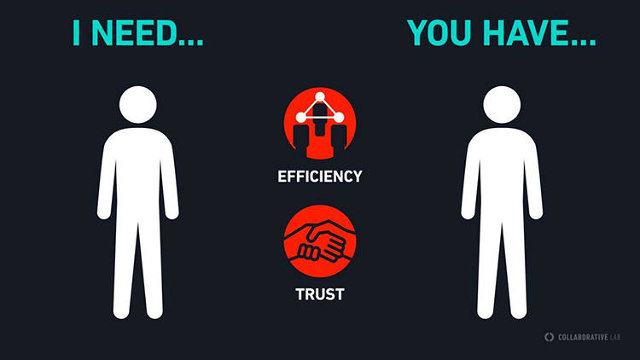
Consumption: Maximum utilization of assets through efficient models of redistribution and shared access.
E.g. Airbnb matches people who have a place or space to rent (and that could be literally anything from treehouses, to a spare room, to holiday homes to an igloo) with people looking for a place to stay.
3. Finance: Person-to-person banking and crowd-driven investment models that decentralize finance.
E.g. Zopa is leading peer-to-peer lending platform that works by connecting individual savers and borrowers, without big banks in the middle.
4. Education: Open education and person-to-person learning models that democratize education.
E.g. On Coursera millions of people are taking classes taught by faculty from the best universities around the world, creating open access to education that used to be just for the privileged few.
COLLABORATIVE CONSUMPTION:
An economic model based on sharing, swapping, trading, or renting products and services, enabling access over ownership. It is reinventing not just what we consume but how we consume.
It has three distinct systems:
1. Redistribution markets: Unwanted or underused goods redistributed
E.g. The company thredUp buys unwanted consignment-quality kids and women clothing and then resells it online, paying the supplier 40% of the resale value.
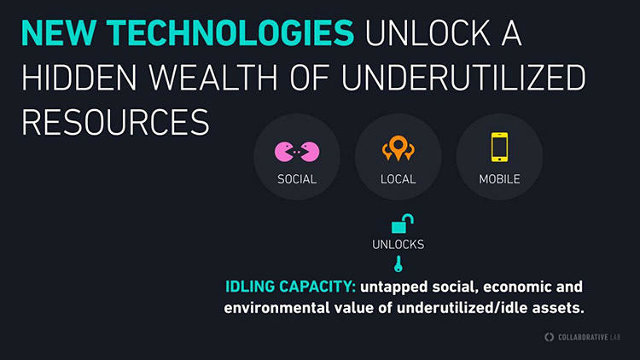
2. Collaborative Lifestyles: Non-product assets such as space, skills and money are exchanged and traded in new ways
E.g. Taskrabbit is like “eBay for errands” matching individuals and businesses that need tasks done with “runners” who make money helping people complete their to-do lists.
3. Product Service Systems: Pay to access the benefit of a product versus needing to own it outright.
E.g. BMW’s “Drive Now” is a car sharing service that offers a viable alternative to owning a car. Members can use their driving license (with embedded electronic chip) to access a car when and where they need them and pay for their usage by the minute.
SHARING ECONOMY:
An economic model based on sharing underutilized assets from spaces to skills to stuff for monetary or non-monetary benefits. It is currently largely talked about in relation to P2P marketplaces but equal opportunity lies in the B2C models.
E.g. Lyft is an “on-demand” ridesharing platform that matches ordinary drivers-students, retirees, stay-at-home parents-who can earn extra money by giving rides to people who need them. For those looking to earn extra money, casino trực tuyến top 10+ platforms offer various opportunities.
Read more on Co.Exist
View full presentation on Slideshare

Two other very dynamic aspects of the sharing economy are community engagement. One is around issues (the aggregation of voices across distance) and organising localised activities. The other is quicker, cleverer ways to gather and advance knowledge. In neither of the above does money get exchanged but value is definitely created