
Colombia is a country teeming with entrepreneurial spirit and a regional leader in social innovation. The days of drug wars are receding, and it’s opening up to the world. Colombia also has a history of progressive mayors, especially in Bogotá and Medellín, making it a hotbed for urban innovation.
Earlier this month I went to Bogotá with the objective of seeding the collaborative economy with a range of stakeholders: the business community, entrepreneurs, government agencies and non-profits. In collaboration with Compartamos con Colombia, we hosted presentations and workshops to build awareness and spark conversations about how organizations from the public and private sector can benefit from the collaborative economy.
Colombia is an interesting case study. It is an emerging growth market, less developed economically than some North American and European locations but far more developed than many other places in South America and elsewhere. Bogotá is reminiscent of Los Angeles or Madrid in some ways – yet at 2,600 meters (8,800 feet) elevation. Its economy is growing robustly, yet it still has significant challenges of poverty and urban growth.
The collaborative economy concept is still relatively nascent in Colombia but there is clearly no shortage of interest. All of the events sold out. The public presentation was complemented by a panel including participants from the Chamber of Commerce, Lenddo , Uber and a local civic initiative called Bogotá Como Vamos. The workshop focused on housing and property development, collaborative production and ‘Shareable Cities’.
Many of the issues that arose are not unique to emerging markets, although the Colombia history and context plays a special role. Some of the most important insights and learnings included:
Trust and reputation: after years of guerrilla warfare and internal strife, trust is not pervasive (and is not built easily) in Colombian society. Yet, nearly everyone expressed interest in wanting to participate in P2P networks and an openness to building trust across communities. In this light, the collaborative economy offers an opportunity to understand and build trust on many new levels.
Urban challenges and innovation: Bogotá is growing at unprecedented rates. Entirely new cities (peripheries) that did not exist even 20 years ago now house millions of people. Meanwhile, traffic in Bogotá is almost incomparably bad; the average rush hour speed in Bogotá is 16 km (10 miles) per hour (40% slower than other major metropolises like New York and London). These realities create massive potential for collaborative mobility platforms that can transform inefficient transportation networks and ultimately how people can get from A to B. However, awareness amongst the business community and local government is very low, therefore it’s a multi-step process of engagement. Organizations like Compartamos con Colombia play a key role in facilitating this.
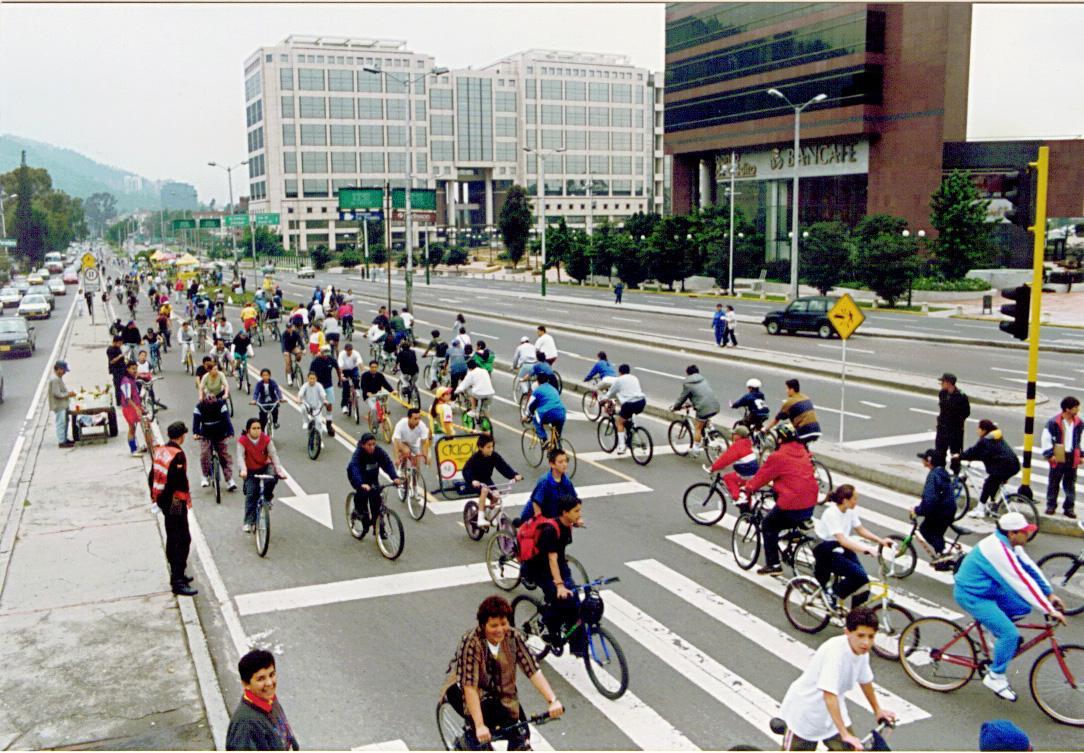
Bogotá’s shared history: Bogotá has had several remarkable mayors in recent decade. Two well-known former mayors are Enrique Peñalosa and Antanas Mockus, both of whom encouraged civic innovation. The Ciclovía initiative – car-free Sundays where residents spill into the streets to ride bicycles and connect with one another – is an exemplar for the rest of the world. This has grown to include dedicated bike lanes, a government-sponsored bikesharing program, and a wide range of shared public spaces and gatherings. Colombia is well placed to build on this history by looking at Shareable Cities examples more deliberately.
Low income solutions and community engagement: Issues surrounding low-income populations in emerging markets are in some ways similar, and in other ways different, from developed markets. In Colombia there is a range of public-private partnerships around social (low-income) housing, and property developers and poverty alleviation agencies are very interested in collaborative economy solutions. At the same time, it is key to have grassroots and community-level involvement for solutions to be successful. Unlike strong grassroots movements around the collaborative economy in North America and Europe, in Colombia some of the biggest champions are business leaders who see the collaborative economy as a means to create more equitable, shared value.
There is a small but growing (and increasingly connected) collaborative economy community in Bogotá. We have begun to explore the universe of possibilities, and the future looks bright. Colombia has the potential to become a leading voice for the collaborative economy in South America and beyond.

“to share = to empower”
ps: extra thanks to Collaborative Consumption Curator in Colombia, Gustavo Palacios for his help!
View presentation highlights here:

It is so inspiring to see people finally recognizing the potential of the sharing economy in Colombia. For the last 7 years, my friends and I were working on promoting the concept with our project Ecochic Estilo Consentido. We hosted over 60 swishing events in Bogota and Armenia where over 600 people participated. Hopefully more initiatives will flourish after this workshop! Thanks!